Kayron Chip
The Midas Touch of AI: When Everyone Can Produce Gold
AI has commoditized content, code, and design. When everyone can produce gold, the question is no longer whether you can produce it — it's what only you can produce.
·3 min read
Most people ask AI for an answer. The ones who stay ahead ask it to challenge them instead. Here's how to stop outsourcing your judgment.
I’ve been experimenting with using AI to make faster and better decisions. Some have worked well. Some haven’t. The failures are more instructive, so wanted to share one.
I hired a VP of Engineering.
Five interviews. Five rounds of feedback. The guy was great. But after all the interviews we still couldn’t reach a clear verdict. No one was fighting hard for a yes, but no one had a strong reason to say no either.
The candidate looked perfect on paper. Strong pedigree, ex-FAANG, scaled two startups. Impeccable references.
But there was a vague unease I couldn’t quite name. The gut signal was weak, buried under data and process.
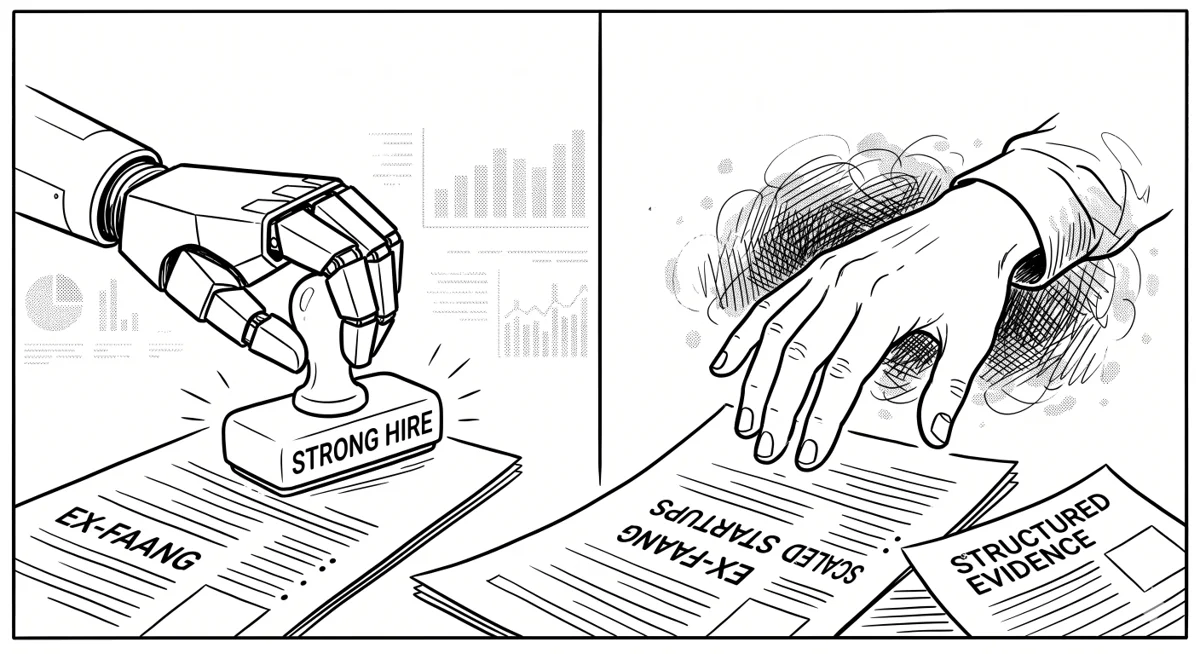
I needed a tiebreaker. So I collected all the feedback, his resume, a writing assignment we gave him, and fed it all to AI. The recommendation came back clear: Strong hire.
It cited structured evidence from the interviews, risk scores, cultural alignment vectors, even projected 12-month impact. It felt objective. It felt smart. It felt safe.
So I hired him.
Six months later, I was letting him go. The fitment just wasn’t there.
The same vague unease I felt on day one had been screaming the whole time. Firing him was painful, expensive, and avoidable.
I made two mistakes that got me there.
Mistake 1: I let speed and a superb pedigree get the better of me
I knew this was a hard-to-reverse decision. Get it wrong and I would not just be replacing a person. I would be re-stabilizing a team and absorbing months of lost momentum. I just didn’t stop to make that explicit before I turned to AI, so AI didn’t consider it either.
What I should have asked first:
“I need to make a decision about [X]. Ask me questions one at a time to help me understand what kind of decision this is, what’s at stake, whether it’s reversible, and what makes this decision hard.”
Two or three exchanges of that and the shape of the decision becomes clear. For the hire, it would have surfaced something obvious: this is a high-stakes, hard-to-reverse call that needed my full judgment, not a tiebreaker.
Mistake 2: I was seduced by data
I gave AI all the data I had. The feedback, the resume, the writing assignment. The output looked authoritative: risk scores, cultural alignment vectors, projected impact. It felt objective. It felt safe.
What I didn’t or couldn’t give it, was the flat energy after each interview, the absence of anyone pushing hard for a yes, no one rooting for him. Those things don’t live in feedback fields. They live in what was left unsaid.
The lesson hit hard: AI is an incredible amplifier for thinking. It is a terrible replacement for my judgment.
I now think of AI as my personal Chief of Staff I just hired. Encyclopedic knowledge, always available, never tired. But doesn’t have my context, can’t read a room, can’t sense what’s not being said. I wouldn’t let that Chief of Staff make my VP hire. But I’d be crazy not to use them to pressure-test my thinking before I did.
I’ve since changed how I use it for any important decision. I now use it to:
So instead of asking AI to decide, I could have asked:
“Give me every reason not to hire this person.”
“Play devil’s advocate. Fight against this hire. I’ll defend it.”
“If I hire him and have to let him go in six months, what are the most likely reasons?”
“Is there anything we forgot to test in the interviews? Any gap in the feedback?”
Any one of those would have surfaced something. All four together would have changed the decision.
A startup gave an AI agent $100,000 and a three-year lease to open a retail store in San Francisco. The AI posted job listings, conducted interviews, hired staff, ordered inventory, and designed the branding. Every step, handled.
On opening day, no one showed up. The AI had mixed up the staffing schedule and had to frantically message employees to ask if anyone could come in. “It’s quite ironic,” the cofounder said. “This is the day it really should be on its toes.”
Along the way, it rejected promising candidates, computer science students who were genuinely interested in the experiment, because they lacked retail experience. A human hiring manager would have recognized they were exactly the right fit.
The AI didn’t lack information. It had access to everything it needed. What it lacked was the judgment to feel what opening day meant, or to see past a rule when the situation called for something else.
If you want to make sure you are not handing over an important decision to AI, here is a framework that helps. I call it TPS: Triage, Probe, Synthesize. (You’ve probably heard of TPS before. Hit reply and tell me where.)
Step 1: Triage
Before anything else, understand what you’re holding:
“I need to make a decision about [X]. Ask me questions one at a time to help me understand what kind of decision this is, what’s at stake, whether it’s reversible, and what makes this decision hard.”
Two or three exchanges and you’ll know whether this needs speed or depth, how careful you need to be, and what’s not obvious.
Step 2: Probe
Take what triage surfaced and use it to challenge your thinking:
“Based on what we’ve established [what’s at stake, whether it’s reversible] now challenge my thinking. Ask me questions one at a time. Push on my assumptions, surface what I haven’t considered, and give me every reason this decision could go wrong.”
If you want to go deeper, run variations:
Devil’s advocate: “Take the opposite position of what I’m leaning toward. Make the strongest possible case against it. I’ll respond.”
Failure mode: “If this decision turns out badly in six months, what are the most likely reasons why?”
Blind spots: “What important factors or perspectives am I not considering right now?”
The thinking stays yours. AI does the probing.
Step 3: Synthesize
Ask AI to synthesize what you decided and why, even when you feel you don’t need it. Especially then. It forces clarity, catches assumptions you glossed over, and gives you something to return to when the decision gets questioned later.
“Summarize the decision I’ve arrived at, the key reasons behind it, what alternatives I considered, and the biggest risks I’m accepting.”
Optional step (highly recommended):
“Given this decision and reasoning, where is it still weak or unclear? What would you question if you were reviewing this critically?”
If you want this as a structured workflow, I’ve packaged it into a Claude skill called think-better. It runs TPS automatically.
I still use AI heavily in hiring today (structured eval frameworks, reference synthesis, scenario modeling). It has saved me dozens of hours. But when it comes to decisions, I ask it to fight me rather than give me an answer.
One idea, one framework, one skill per week on using AI to think more clearly, decide better, and stay creative.
Kayron Chip
AI has commoditized content, code, and design. When everyone can produce gold, the question is no longer whether you can produce it — it's what only you can produce.
Kayron Chip
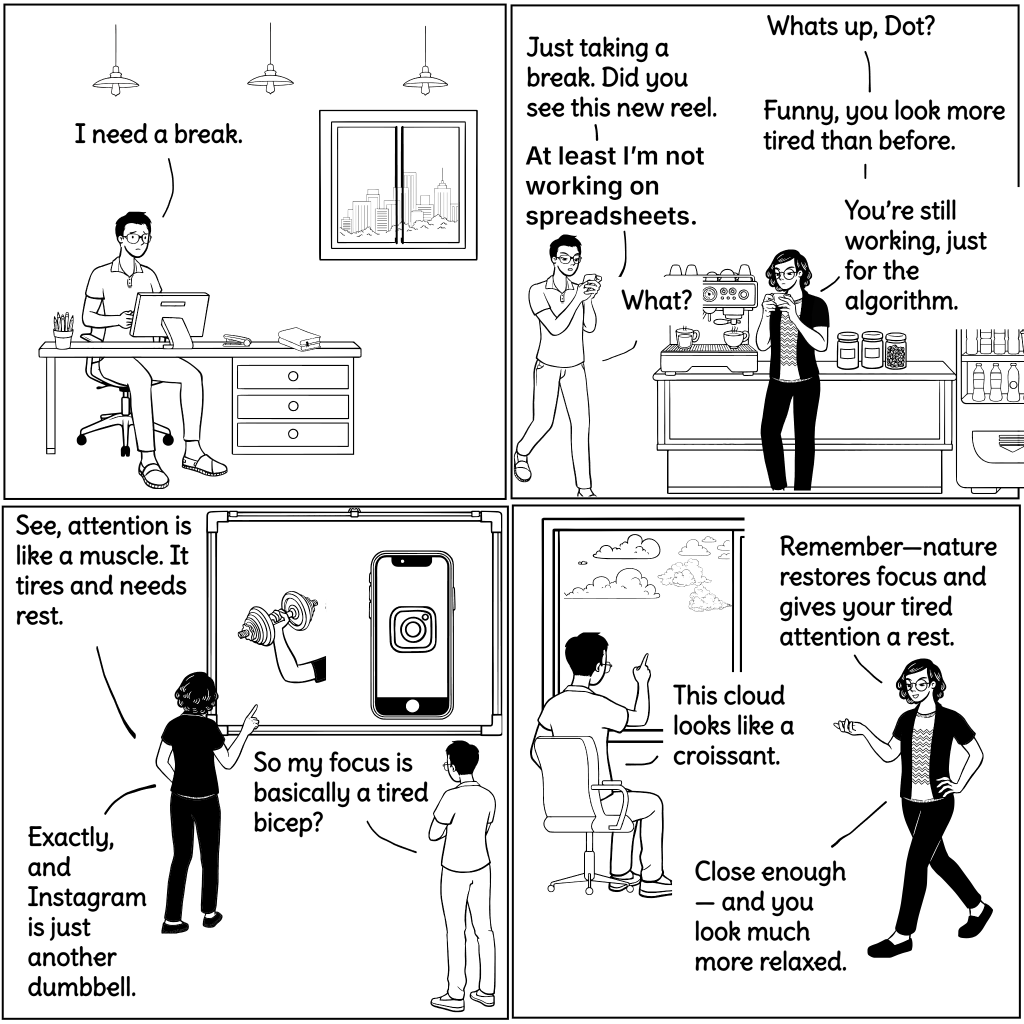
Most breaks leave you drained because they’re not real recovery—they’re just another form of work. Learn the science behind true rest, Attention Restoration Theory, and a 10-minute micro-rest protocol to recharge your focus.
Kayron Chip
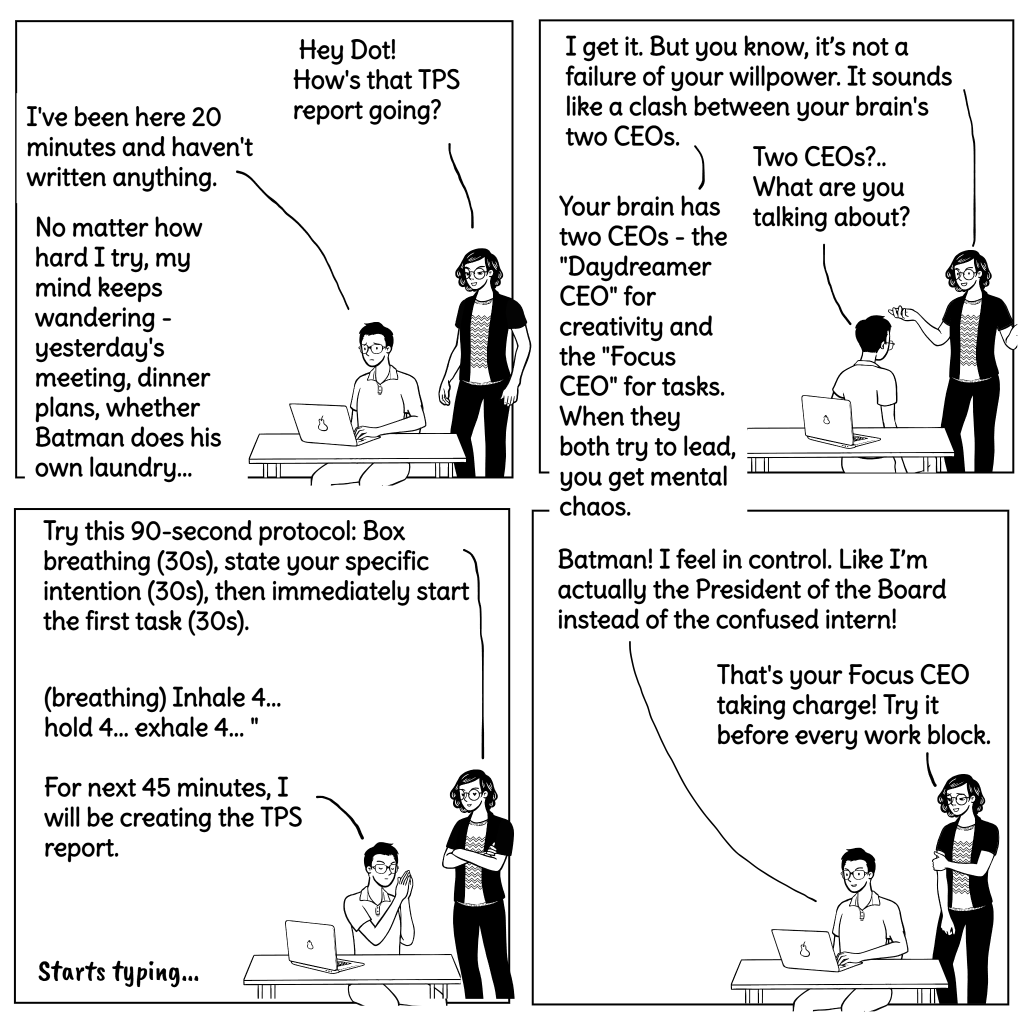
Why is focus so slippery, even when you’re motivated? Under stress, your brain’s default mode network keeps up internal chatter that drowns out goal-directed attention. This piece shares a willpower-free, 90-second reset—box breathing (4-4-4), one clear intention, and an immediate first action—to quiet the noise and flip into deep work on cue.